

What Is a Mediation Brief?
A mediation brief (sometimes called a mediation statement) is a document submitted to the mediator before the session. It explains the dispute, summarizes each side’s view of the facts and the issues, describes where negotiations have stood so far, and tells the mediator what the party is hoping to accomplish.
It is not a court filing, and it is not written to win a ruling. There is no judge to persuade. The audience is a neutral who will spend the day helping the parties find an outcome both can accept, and the best mediation briefs are written with that in mind.
When Is a Brief Useful?
Not every mediation needs one. A simple dispute with a single issue and a few thousand dollars at stake may not justify the effort. Briefs tend to earn their keep when:
- The dispute involves multiple issues, parties, or claims
- There is a significant amount of money, property, or a long-term relationship at stake
- The facts or documents are complicated enough that the mediator will benefit from reading them in advance
- A lawsuit is already underway, and the mediator needs to understand where the case stands procedurally
- The parties have already been negotiating and the mediator needs to know what has been offered and rejected
Even when a brief isn’t required, a short one (two or three pages) can make a real difference.
Why Write One: Benefits for the Mediator and the Parties
It helps the parties prepare. This is the benefit people overlook. Writing a brief forces a party to do the thinking that the last post in this series urged: figure out what you actually want and why, separate your interests from your positions, decide what you can live with, and gather the facts and documents that support your view. A person who has written all of this down walks into mediation noticeably more focused than one who is figuring it out on the fly.
It helps the mediator evaluate the case. A mediator who has read the briefs in advance doesn’t spend the first hour of the session getting up to speed. The mediator can see where the real disagreements are, where the parties are closer than they realize, and which issues are likely to be sticking points.
It surfaces strengths and weaknesses, on both sides. A good brief doesn’t just argue its own case. It anticipates the other side’s best arguments and addresses them. That gives the mediator a clearer picture of each party’s risks, which is exactly what the mediator needs to help each side take a realistic look at its own case, and at the other side’s. Most disputes look very different from the other side of the table, and a mediator can use that information, carefully, to help parties see what they’ve been missing.
What Should Go in a Mediation Brief?
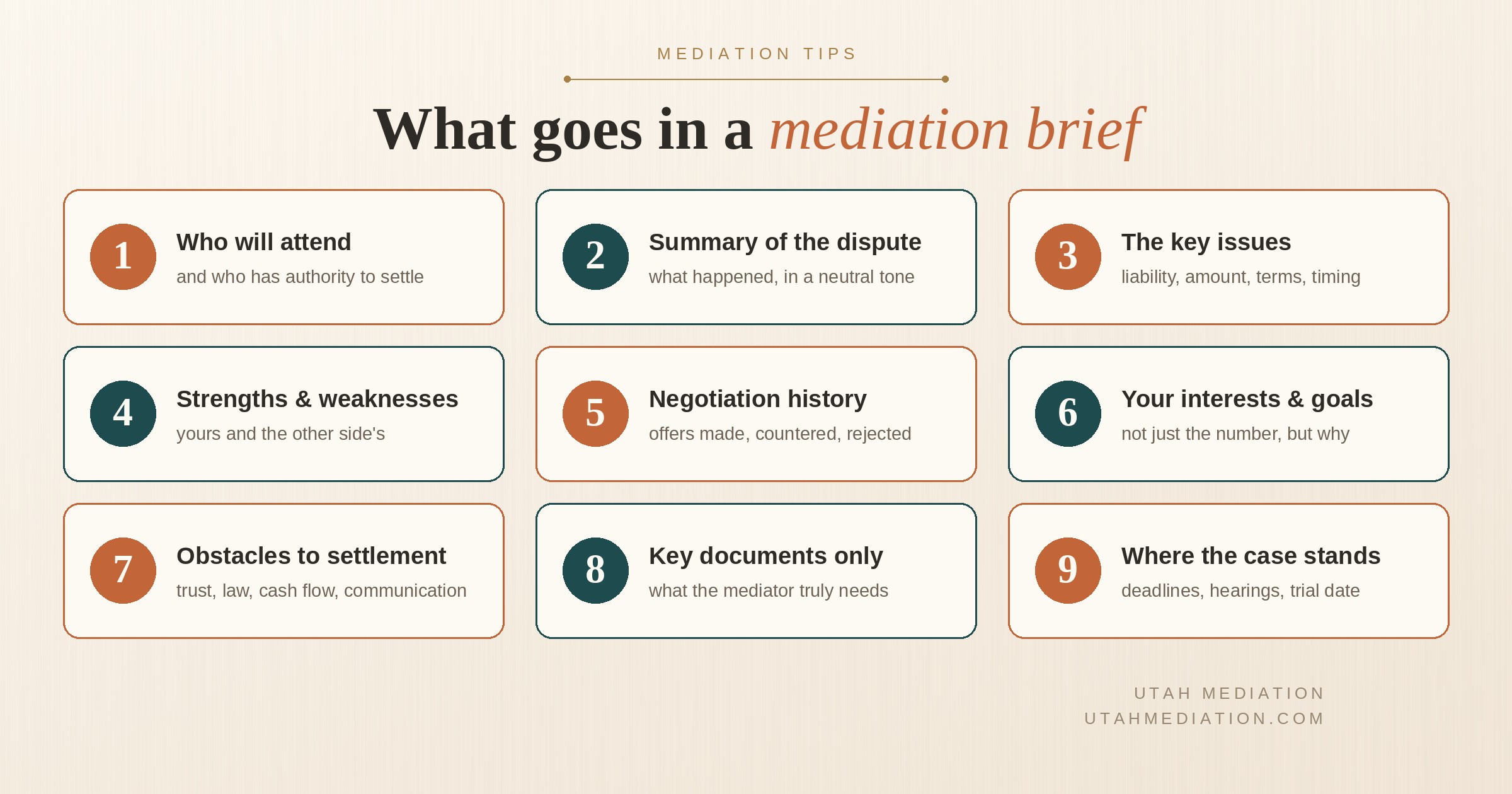
Keep it focused. A good brief is usually a few pages, not a few dozen, and typically covers:
- The parties and the people who will be there. Who is attending, and who has the authority to settle?
- A concise summary of the dispute. What happened, in a neutral enough tone that the mediator trusts the rest of the document.
- The key issues. What exactly is in dispute: liability, amount, terms, timing, something else?
- Your view of the strengths and weaknesses. Yours and the other side’s. Candor here is worth more than polish.
- The history of negotiations. What has been offered, countered, or rejected, so the mediator doesn’t have to rediscover it.
- Your interests and goals. Not just the number you want, but why, and what else would matter, such as timing, privacy, an apology, or an ongoing relationship.
- Obstacles to settlement. Is it a trust problem, a communication problem, a legal question, a cash-flow issue?
- Key documents. Attach what the mediator genuinely needs (the contract, the key email, the demand letter) rather than the entire file.
- Where the case stands procedurally, if litigation is pending: deadlines, upcoming hearings, trial date.
Tell the Mediator What Is Confidential, and What Isn’t
This may be the single most important practical point about mediation briefs, and it is the one most often handled badly.
A brief can contain two very different kinds of information: things you are happy for the other side to read, and things you are telling the mediator in confidence. Candid assessments of weaknesses, your real bottom line, concerns about a witness, settlement authority, or family dynamics you’d rather not air can be extremely helpful to a mediator, but only if you are sure they will stay with the mediator.
A few ways to keep it clean:
- Say it explicitly. State at the start whether the brief is for the mediator’s eyes only, for sharing with the other side, or partly both.
- Consider two documents. A shareable brief that sets out your position and the facts, and a short confidential cover letter with the candid material, is often the cleanest approach.
- Mark the sections if you use a single document, and tell the mediator what, if anything, may be shared during the session and in what form.
- Don’t assume. Mediators differ in their practices. If you aren’t sure how your mediator treats a brief, ask before you submit it.
Done right, this gives the mediator full information while preserving your ability to speak freely. Done carelessly, it can reveal exactly what you didn’t want revealed.
The Honest Truth About Cost
Mediation briefs are not free. Your own attorney needs time to prepare one, and the mediator needs time to read it, and mediators generally bill for that time. For a modest dispute, that can be a noticeable add-on.
In practice, though, those costs are often offset. A prepared mediator and prepared parties spend less of the session on background and more of it on solutions. Sessions run shorter, impasses are less common, and the likelihood of settling goes up. Add the cost of an extra session, or of continued litigation if the case doesn’t resolve, and the brief is frequently the cheapest part of the process. The right question is rarely “Can we skip it to save money?” It is “How much brief does this dispute need?”
A Few Practical Tips
- Write for the mediator, not a judge. Argue less, explain more.
- Be candid. A brief that acknowledges the weak spots in your case is more credible, and more useful, than one that insists you can’t lose.
- Watch the tone. If you plan to share it, remember the other side will read it. Inflammatory language can undo the very progress the mediation is meant to create.
- Get it in on time. Mediators usually ask for briefs a few days before the session. A late brief is a brief that may not get read.
- Let your client read it. The party should see the brief and agree with it. It is also a good prompt for the client’s own preparation.
The Bottom Line
A mediation brief is a preparation tool as much as a communication tool. It gets the mediator ready, it gets you ready, and it points everyone toward the issues that actually matter. Used well, with clear instructions about what stays private and what can be shared, it is one of the most efficient ways to make a mediation session count.
Ready to Resolve Your Dispute?
If you’re facing a dispute and wondering whether mediation is right for you, or what to prepare before a session, we’re here to help. Reach out to us today to talk about how we can help you and the other party reach a resolution that works for everyone involved.