
Mediation Briefs: What They Are, When They Help, and What to Put in Them

Illustration of two professionals reviewing documents at a conference table, representing preparation for mediation.

What Is a Mediation Brief?

A mediation brief (sometimes called a mediation statement) is a document submitted to the mediator before the session. It explains the dispute, summarizes each side’s view of the facts and the issues, describes where negotiations have stood so far, and tells the mediator what the party is hoping to accomplish.

It is not a court filing, and it is not written to win a ruling. There is no judge to persuade. The audience is a neutral who will spend the day helping the parties find an outcome both can accept, and the best mediation briefs are written with that in mind.

When Is a Brief Useful?

Not every mediation needs one. A simple dispute with a single issue and a few thousand dollars at stake may not justify the effort. Briefs tend to earn their keep when:

  • The dispute involves multiple issues, parties, or claims
  • There is a significant amount of money, property, or a long-term relationship at stake
  • The facts or documents are complicated enough that the mediator will benefit from reading them in advance
  • A lawsuit is already underway, and the mediator needs to understand where the case stands procedurally
  • The parties have already been negotiating and the mediator needs to know what has been offered and rejected

Even when a brief isn’t required, a short one (two or three pages) can make a real difference.

Why Write One: Benefits for the Mediator and the Parties

It helps the parties prepare. This is the benefit people overlook. Writing a brief forces a party to do the thinking that the last post in this series urged: figure out what you actually want and why, separate your interests from your positions, decide what you can live with, and gather the facts and documents that support your view. A person who has written all of this down walks into mediation noticeably more focused than one who is figuring it out on the fly.

It helps the mediator evaluate the case. A mediator who has read the briefs in advance doesn’t spend the first hour of the session getting up to speed. The mediator can see where the real disagreements are, where the parties are closer than they realize, and which issues are likely to be sticking points.

It surfaces strengths and weaknesses, on both sides. A good brief doesn’t just argue its own case. It anticipates the other side’s best arguments and addresses them. That gives the mediator a clearer picture of each party’s risks, which is exactly what the mediator needs to help each side take a realistic look at its own case, and at the other side’s. Most disputes look very different from the other side of the table, and a mediator can use that information, carefully, to help parties see what they’ve been missing.

What Should Go in a Mediation Brief?

Keep it focused. A good brief is usually a few pages, not a few dozen, and typically covers:

  1. The parties and the people who will be there. Who is attending, and who has the authority to settle?
  2. A concise summary of the dispute. What happened, in a neutral enough tone that the mediator trusts the rest of the document.
  3. The key issues. What exactly is in dispute: liability, amount, terms, timing, something else?
  4. Your view of the strengths and weaknesses. Yours and the other side’s. Candor here is worth more than polish.
  5. The history of negotiations. What has been offered, countered, or rejected, so the mediator doesn’t have to rediscover it.
  6. Your interests and goals. Not just the number you want, but why, and what else would matter, such as timing, privacy, an apology, or an ongoing relationship.
  7. Obstacles to settlement. Is it a trust problem, a communication problem, a legal question, a cash-flow issue?
  8. Key documents. Attach what the mediator genuinely needs (the contract, the key email, the demand letter) rather than the entire file.
  9. Where the case stands procedurally, if litigation is pending: deadlines, upcoming hearings, trial date.
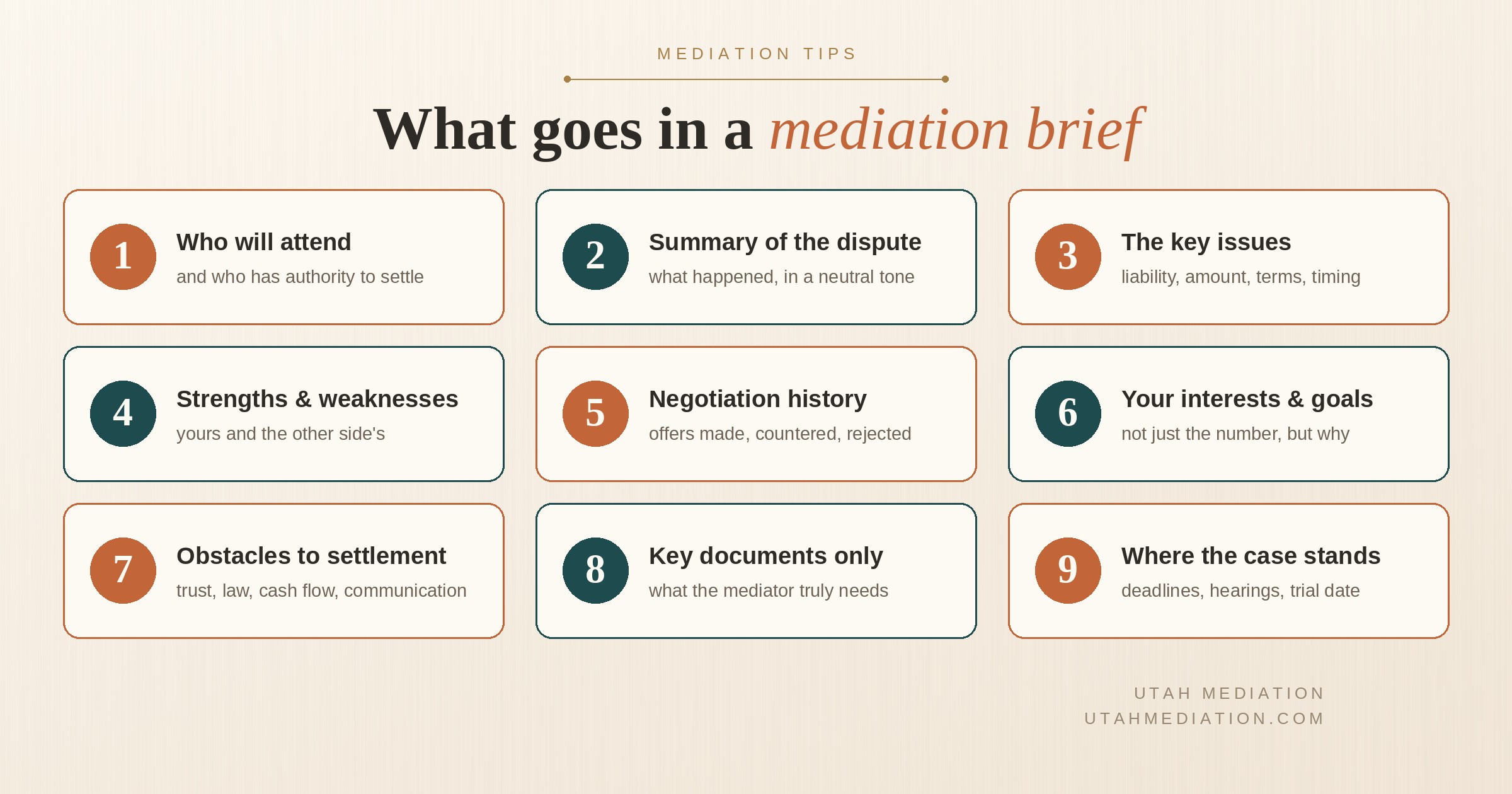
Checklist graphic: what goes in a mediation brief, nine items from who will attend to where the case stands.

Tell the Mediator What Is Confidential, and What Isn’t

This may be the single most important practical point about mediation briefs, and it is the one most often handled badly.

A brief can contain two very different kinds of information: things you are happy for the other side to read, and things you are telling the mediator in confidence. Candid assessments of weaknesses, your real bottom line, concerns about a witness, settlement authority, or family dynamics you’d rather not air can be extremely helpful to a mediator, but only if you are sure they will stay with the mediator.

A few ways to keep it clean:

  • Say it explicitly. State at the start whether the brief is for the mediator’s eyes only, for sharing with the other side, or partly both.
  • Consider two documents. A shareable brief that sets out your position and the facts, and a short confidential cover letter with the candid material, is often the cleanest approach.
  • Mark the sections if you use a single document, and tell the mediator what, if anything, may be shared during the session and in what form.
  • Don’t assume. Mediators differ in their practices. If you aren’t sure how your mediator treats a brief, ask before you submit it.

Done right, this gives the mediator full information while preserving your ability to speak freely. Done carelessly, it can reveal exactly what you didn’t want revealed.

The Honest Truth About Cost

Mediation briefs are not free. Your own attorney needs time to prepare one, and the mediator needs time to read it, and mediators generally bill for that time. For a modest dispute, that can be a noticeable add-on.

In practice, though, those costs are often offset. A prepared mediator and prepared parties spend less of the session on background and more of it on solutions. Sessions run shorter, impasses are less common, and the likelihood of settling goes up. Add the cost of an extra session, or of continued litigation if the case doesn’t resolve, and the brief is frequently the cheapest part of the process. The right question is rarely “Can we skip it to save money?” It is “How much brief does this dispute need?”

A Few Practical Tips

  • Write for the mediator, not a judge. Argue less, explain more.
  • Be candid. A brief that acknowledges the weak spots in your case is more credible, and more useful, than one that insists you can’t lose.
  • Watch the tone. If you plan to share it, remember the other side will read it. Inflammatory language can undo the very progress the mediation is meant to create.
  • Get it in on time. Mediators usually ask for briefs a few days before the session. A late brief is a brief that may not get read.
  • Let your client read it. The party should see the brief and agree with it. It is also a good prompt for the client’s own preparation.

The Bottom Line

A mediation brief is a preparation tool as much as a communication tool. It gets the mediator ready, it gets you ready, and it points everyone toward the issues that actually matter. Used well, with clear instructions about what stays private and what can be shared, it is one of the most efficient ways to make a mediation session count.

Ready to Resolve Your Dispute?

If you’re facing a dispute and wondering whether mediation is right for you, or what to prepare before a session, we’re here to help. Reach out to us today to talk about how we can help you and the other party reach a resolution that works for everyone involved.

How to Get the Most Out of Mediation: What Participants Can Do to Help It Succeed

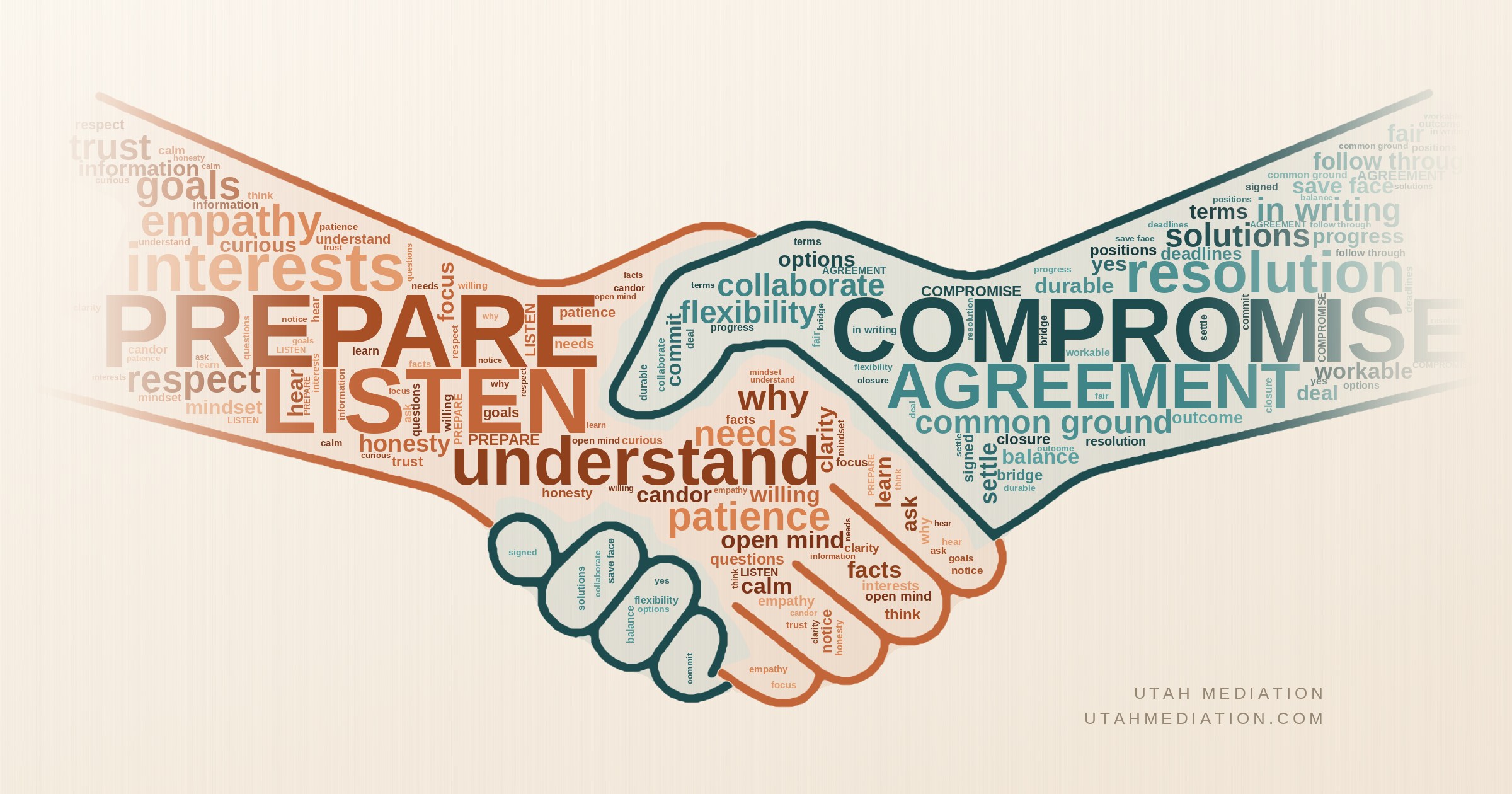
Word cloud in the shape of two hands shaking, with words like listen, prepare, compromise and agreement, from Utah Mediation.

Mediation works. But it works best when the people in the room — or on the Zoom call — show up ready to make it work. A skilled mediator can guide the process, but the outcome still depends heavily on what each party brings to the table.

If you have a mediation coming up, here are the things that consistently separate a successful session from one that stalls out.

1. Come With a Goal, Not Just a Grievance

It’s natural to walk into mediation focused on what the other side did wrong. But mediation isn’t a courtroom, and dwelling on blame rarely moves things forward. Before your session, take time to think through what you actually want to walk away with. Is it a specific dollar amount? A change in behavior? A workable schedule? Clarity on that goal — for yourself, even before you share it with anyone — makes it much easier to recognize a good offer when one appears.

2. Separate Your Interests From Your Position

Your “position” is what you’re demanding. Your “interest” is why you’re demanding it. Two people can hold opposite positions while sharing overlapping interests — and mediation works by finding that overlap. If you can walk in knowing not just what you want but why you want it, you give your mediator far more to work with, and you open the door to solutions you might not have considered on your own.

Pull quote graphic: "Know why you want it, not just what you want." Mediation tips from Utah Mediation.

3. Be Willing to Actually Listen

This sounds obvious, but it’s the single most common thing that derails a mediation. Many people spend the other side’s talking time mentally preparing their rebuttal instead of listening. Try to genuinely absorb what the other party is saying — not because you have to agree with it, but because understanding their perspective is often the fastest route to a resolution that works for both of you.

4. Expect to Compromise — and Decide in Advance What You Can Live With

Mediation rarely ends with one side getting everything it wanted. Going in with a rigid, all-or-nothing mindset is one of the fastest ways to end a session at impasse. Before you arrive, think honestly about where your true limits are versus where you’re just anchoring for negotiation purposes. Knowing the difference in advance keeps you from getting stuck in the moment.

5. Keep Emotion in Check — But Don’t Suppress It Entirely

Disputes are personal, and it’s unrealistic to expect anyone to feel nothing. But emotional outbursts — yelling, personal attacks, ultimatums — tend to harden the other side’s position rather than soften it. At the same time, a mediator often needs to understand how a dispute has actually affected you in order to help craft a resolution that addresses it. The goal isn’t to be a robot; it’s to express what matters without letting the emotion take over the room.

6. Trust the Process, Including the Separate Conversations

If your mediator uses shuttle diplomacy — moving between separate rooms rather than keeping everyone together — trust that this is working in your favor, not against it. It can feel strange not to hear everything the other side says directly. But this structure exists specifically to get both sides to a resolution that a face-to-face conversation might not reach. Give your mediator the candor in private caucus that you might not be ready to share in a joint session.

7. Come Prepared With Information, Not Just Opinions

Vague assertions are hard to negotiate around. If your dispute involves money, bring the numbers. If it involves a contract, bring the contract. If it involves a timeline of events, have it organized. The more concrete information you bring, the less time gets spent arguing about facts and the more time is available to actually negotiate a resolution.

8. Give the Other Side Room to Save Face

Especially in disputes between people who will continue to have a relationship — business partners, neighbors, family members — a resolution that humiliates the other side rarely holds up well over time. Look for ways to let the other party agree to terms without feeling like they’ve been defeated. This isn’t about letting them off easy; it’s about making an agreement more durable.

9. Be Prepared to Reduce Your Agreement to Writing

A resolution reached at the table isn’t final until it’s in writing, and parties are sometimes caught off guard by how much work that last step can take. It’s worth thinking about the settlement agreement before you ever sit down to mediate — not the specific terms, which still need to be negotiated, but the shape of the document itself.

If both sides are represented by counsel, the attorneys can often agree in advance on the boilerplate: governing law, confidentiality, how disputes over the agreement itself will be handled, and other standard provisions that have nothing to do with the substance of the dispute. That way, the only real work left at the end of mediation is filling in the terms that were actually negotiated.

Even when one or both parties aren’t represented, circulating a proposed form of agreement ahead of time can still help. Nobody wants to review and sign a dense legal document for the first time in the same sitting where they’re also feeling pressure to close out a long negotiation. Giving people a chance to get familiar with the structure of the agreement beforehand means they’re not learning the document and negotiating the dispute at the same time — and it lets everyone’s attention stay focused on the actual points of disagreement, where it belongs.

Beyond the writing itself, treat every deadline in the final agreement seriously — a payment, a signature, a delivery, a change in conduct. Nothing undermines the goodwill built during a successful mediation faster than one side dragging its feet on terms it just agreed to.

The Bottom Line

Mediation gives disputing parties something litigation can’t: control over the outcome. But that control comes with responsibility. The parties who get the most out of mediation are the ones who show up prepared, willing to listen, and genuinely open to a resolution — not just a win.

Ready to Resolve Your Dispute?

If you have a conflict that could benefit from mediation, we’re here to help. Reach out to us today to talk about how we can help you and the other party reach a resolution that works for everyone involved.
Shuttle Diplomacy: Why a Mediator Going Back and Forth Can Get You to “Yes”

If you’ve ever been part of a dispute — a business falling-out, a boundary disagreement with a neighbor, a contentious divorce, a partnership gone sideways — you know the moment when two people simply can’t be in the same room without the conversation breaking down. Voices rise. Old grievances resurface. Nothing gets resolved, and everyone leaves more entrenched than when they arrived.

This is exactly the situation “shuttle diplomacy” is built to solve.

What Is Shuttle Diplomacy?

Shuttle diplomacy is a mediation technique where the mediator moves back and forth between separate rooms — one party in each — rather than running a single joint negotiation. Instead of sitting both sides across a table from each other, the mediator meets privately with Party A, then walks down the hall (or, just as often today, clicks into a separate Zoom breakout room) to meet privately with Party B, carries proposals and concerns between the two, and repeats the process until the parties converge on a resolution.

These days, “the other room” is just as likely to be virtual as physical. Video conferencing platforms let a mediator place each party in its own breakout room and move between them with a click — no hallway required. The dynamic is the same whether the parties are down the hall or in different time zones logging in from home: each side gets a private, undistracted space, and the mediator carries the conversation between them.

The term comes from international diplomacy — most famously Henry Kissinger’s travels between Middle Eastern capitals in the 1970s, ferrying proposals between governments that would not sit down together directly. Mediators borrowed the concept because the same basic problem shows up constantly in far more ordinary disputes: two parties who have something to gain from resolving their conflict, but who cannot productively negotiate face-to-face.

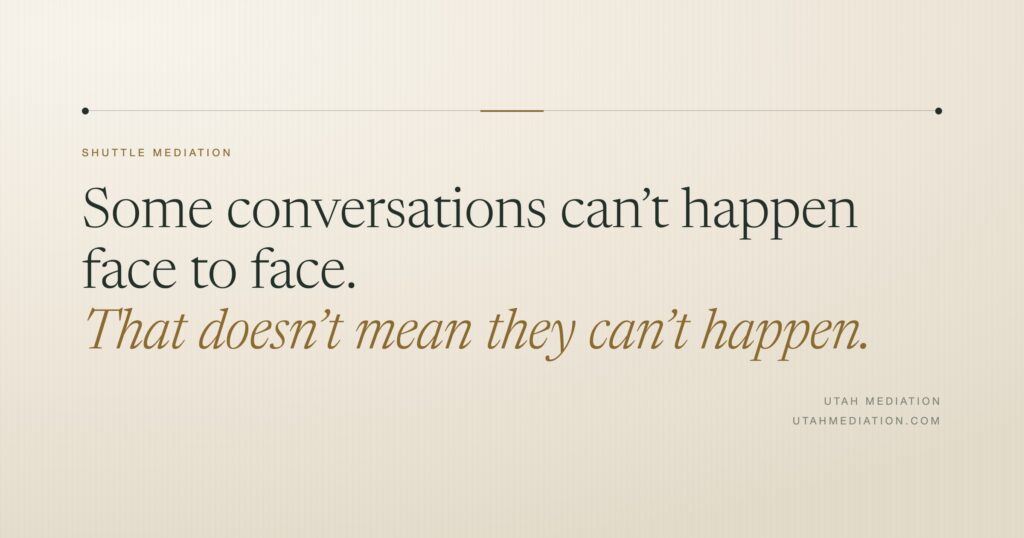
Quote graphic reading: Some conversations can't happen face to face. That doesn't mean they can't happen.

Why It Works

It removes the emotional trigger. In any disputes, the *presence* of the other person is itself the obstacle. Body language, tone of voice, or even just a familiar face can reignite old conflict before a single substantive word is exchanged. Separating the parties strips away that friction and lets each side focus on the merits of a proposal rather than their reaction to the messenger.

It gives people room to be honest. Away from the other party, people tend to speak more candidly with the mediator — about what they actually need, what they’re afraid of, and where they’re genuinely willing to bend. That information rarely surfaces in a joint session where each side is performing for the other.

It lets the mediator reframe. A demand that sounds like an attack when delivered directly (“You owe me for the damage you caused”) can be reframed by a neutral mediator into language the other side can actually hear (“There’s a proposal to address the repair costs — here’s the reasoning behind it”). The mediator acts as a translator, stripping out the hostility while preserving the substance.

It slows things down productively. The back-and-forth naturally paces the negotiation. Each side has time to think between rounds instead of reacting in the heat of the moment, which tends to produce more considered offers and fewer regretted concessions.

It lets the mediator test the water before committing anyone. A mediator can float a hypothetical — “Would you consider something in this range?” — without either party having to make a formal offer on the record. That flexibility often gets both sides moving before they’d otherwise be willing to.

When It’s the Right Tool

Shuttle diplomacy isn’t necessary for every mediation — some disputes benefit from parties talking directly, once tempers are manageable and trust exists. But it tends to be especially effective when:

  • There’s a high degree of personal animosity or a history of conflict between the parties
  • There’s a significant power imbalance that makes direct negotiation uncomfortable or unproductive for one side
  • Emotions are running high enough that face-to-face discussion is likely to escalate rather than resolve
  • The parties have already tried to negotiate directly and hit a wall

A skilled mediator will often move fluidly between formats within a single session — starting separated (whether in different rooms or different Zoom breakout rooms), bringing the parties together once real progress has been made, and separating again if things get tense.

The Bottom Line

Shuttle diplomacy works because it treats the process of negotiation as something that can be designed, not just the outcome. By controlling who talks to whom, when, and how — in person or over video — a mediator can often get parties to a resolution that direct negotiation never would have reached — not because the underlying dispute changed, but because the path to talking about it did.

If you’re in a dispute that feels stuck, it may not be the substance of the disagreement holding things up — it may be the format of the conversation. That’s often where a mediator can help most.

Ready to Resolve Your Dispute?

If you’re dealing with a conflict that feels stuck — whether it’s a business dispute, a boundary or property disagreement, a family matter, or something else entirely — we’re here to help. Reach out to us today to talk about how mediation, including shuttle diplomacy, can help you and the other party reach a resolution without the cost and stress of litigation.

What is Mediation?

If you’ve come to this website, chances are you are facing some kind of conflict.  You may already be involved in a lawsuit, or you may just have a disagreement with a family member, neighbor, or business associate and you are looking for some help to resolve it.  Sometimes courts will order disputing parties to mediate, and that leaves them asking, “What is mediation?”

Mediation is one of several forms of alternative dispute resolution.  Alternative dispute resolution, sometimes called, “ADR,” is any means of dispute resolution other than a court trial.  Mediation is one form of ADR, but ADR can also include unassisted negotiation, neutral evaluation, summary non-binding jury trial, and arbitration.  The Utah Alternative Dispute Resolution Act defines mediation as, “a private forum in which one or more impartial persons facilitate communication between parties  to a civil action to promote a mutually acceptable resolution or settlement.”  Although the Act refers to parties to a civil action, mediation can also occur between persons in conflict before any civil action (a lawsuit) has been commenced.

One of the defining characteristics of mediation is the involvement of an impartial person to facilitate the parties’ efforts to resolve their dispute.  This person is called a mediator.  Many, but not all, mediators are attorneys, who use their years of experience in  resolve disputes to facilitate communication and promote resolution.  Mediators, whether they are attorneys or not, do not represent any of the parties involved in the conflict.  A mediator can only do mediate matters in which he or she can remain impartial and evenhanded, demonstrating fairness to all parties involved in the conflict.

Mediation occurs in a private setting.  The parties, often in consultation with their attorneys, get to choose the mediator. The mediation also occurs in a location on which the parties agree; sometimes at the mediator’s office, sometimes at the office of one of the parties or their lawyer, or at any other place at which the parties are comfortable, safe, and willing to discuss their conflict.

Mediators do not decide or resolve conflict for the parties.  Mediation is founded on the principle of self-determination — the idea that people can and should make decisions about their own lives.  In mediation, the parties speak for themselves, think for themselves, and decide for themselves.  That doesn’t mean that the parties necessarily come away from mediation with everything they thought they wanted when the mediation started.  Rather, through the process of mediation, the parties may come to realize that compromise is in their best interest, and so they choose a resolution that, although less than ideal, is better for them than the alternatives of continuing the conflict, or leaving it to the court to decide.  Resolving conflict through mediation has the great advantage that the resolution is one that the parties choose.